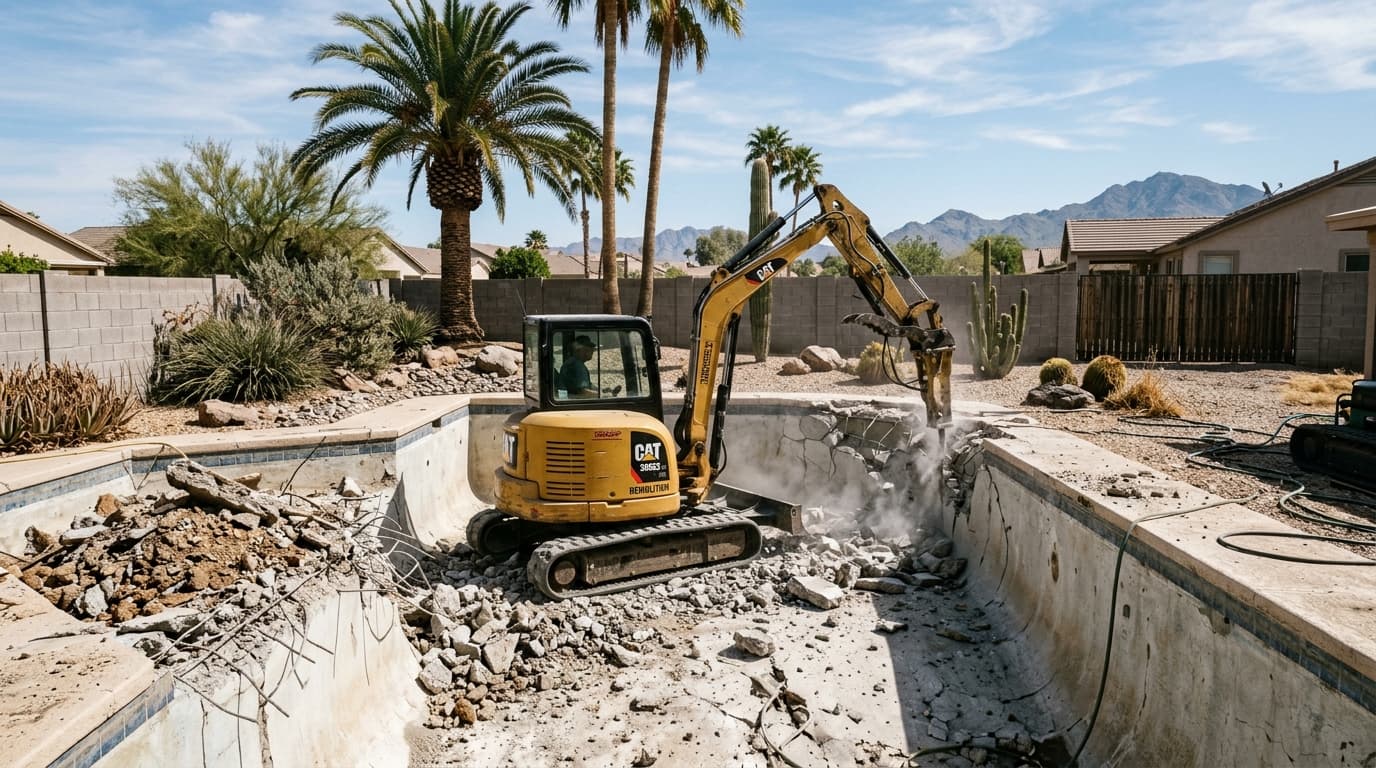
Fiberglass vs. Concrete Pool Removal | Cost, Speed, and Process Compared
Removing an Arizona pool is not one-size-fits-all. Concrete requires heavy hydraulic breaking, while fiberglass is a specialized "cut and lift" operation. Learn which one you have and what it costs to remove.
Select Your Pool Type
The Concrete Challenge
Standard in Mesa since the 1970s, concrete (Gunite) pools are permanent structural fixtures. Removal involves high-decibel hydraulic breaking to shatter a 6–10 inch thick reinforced shell.
- → Requires hydraulic hammers/breakers
- → Generates significant concrete debris (hauling-heavy)
- → 40-year shells often brittle and hard to break
- → Best for homeowners planning new structures over the footprint
We provide site-specific pricing for both materials across the East Valley.
The Head-to-Head Breakdown
| Feature | Concrete (Gunite) | Fiberglass |
|---|---|---|
| Primary Cost Factor | Excavation & Hauling Weight | Hauling Volume & Cutting |
| Time to Complete | 4–6 Days | 2–3 Days |
| Debris Weight | High (30–60 Tons) | Low (2–5 Tons) |
| Equipment Noise | High (Hydraulic Breakers) | Moderate (Saws/Winches) |
| Backfill Requirement | High-Compaction Engineered Fill | Standard Engineered Backfill |
Wait: Caliche Still Matters for Both
Whether your pool is concrete or fiberglass, the soil beneath it in Mesa is likely caliche. Even for fiberglass pools, which are easier to lift out, we often have to break through caliche side-walls to properly grade the yard for drainage.
Read how caliche affects your removal budget →
Unsure Which Material You Have?
We provide free on-site material identification and cost assessments.
Get Your Free Assessment